Pre-MOT Checklist UK
Around 40% of MOT failures in the UK are for issues that could have been spotted and fixed beforehand. This complete checklist takes 20–30 minutes and could save you the cost of a failure and retest.
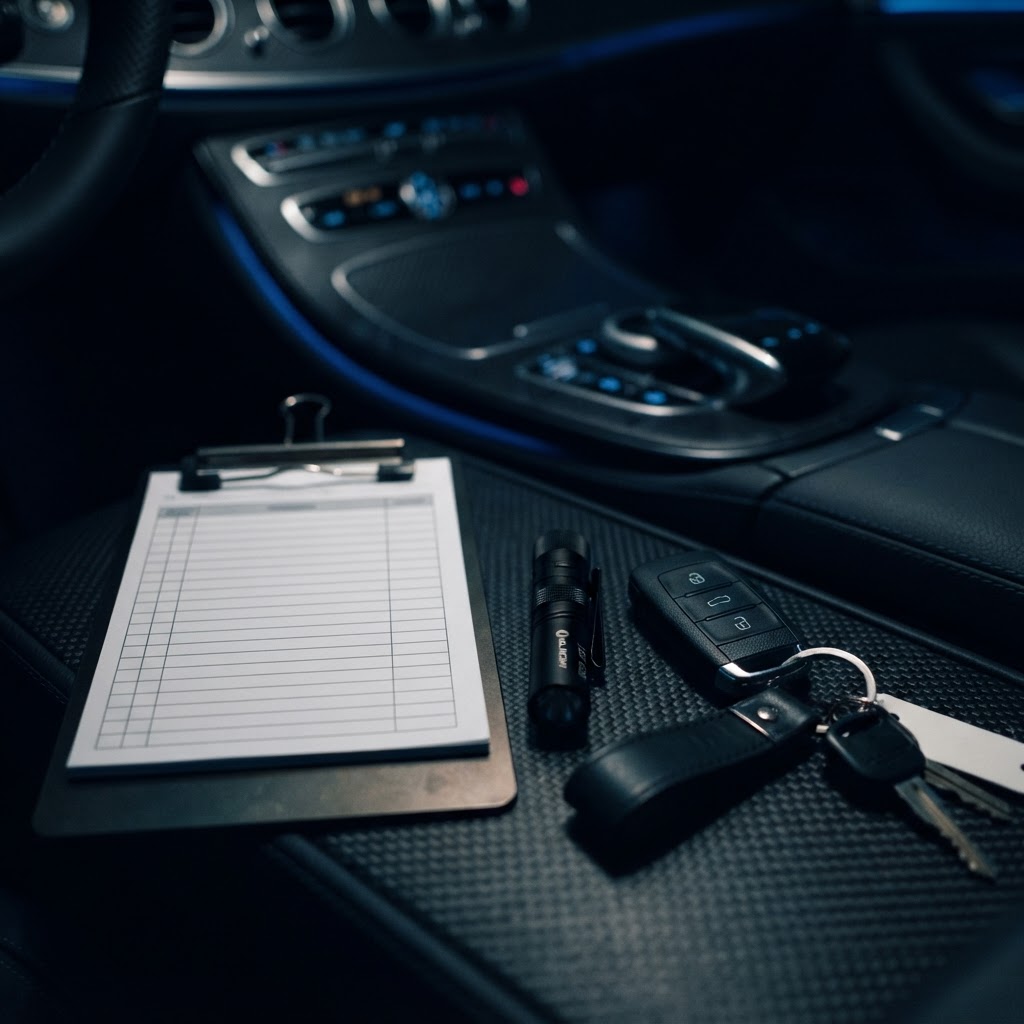
A 30-minute check prevents most avoidable failures
Before your MOT, check: all lights (headlights, indicators, brake lights, fog lights, number plate), tyre tread depth (3mm+) and pressures, wiper blades (no smearing), screenwash filled, horn working, fuel cap sealing, all seat belts latching, brake pedal firm, no dashboard warning lights illuminated, and windscreen free from cracks in the driver's line of sight. Most common MOT failure category: lighting faults.
Lights (most common MOT failure category)
Tyres
Windscreen and visibility
Brakes
Other checks
Understanding MOT Defect Categories Before Your Test
The DVSA classifies every MOT defect into four categories. Understanding these helps you know what to check — and what will cause a failure versus a pass with an advisory:
| Defect category | Result | What it means for your pre-MOT check |
|---|---|---|
| Dangerous | Fail — cannot drive | Must be fixed before the test; cannot leave test centre |
| Major | Fail — must repair before retest | Must be fixed before the test or will fail |
| Minor | Pass — repair soon | Can pass with this; but fix before it becomes Major |
| Advisory | Pass — monitor | Noted for future; monitor and repair at next service |
Source: DVSA MOT inspection manual. A pre-MOT check aims to catch items before they become Major or Dangerous.
The Most Common Preventable MOT Failures
DVSA data shows that around 40% of MOT failures are for issues that could have been spotted and fixed beforehand. Here are the top preventable failures and how to check for each:
| Failure | Share of failures | How to check at home | Fix cost |
|---|---|---|---|
| Blown bulb (headlight, brake, indicator) | ~30% | Walk around the car; check all lights | £5–£25 per bulb |
| Screenwash empty | ~5% | Check reservoir; top up with diluted fluid | £3–£8 for screenwash |
| Wiper blades smearing | ~3% | Test wipers; look for streaks or chattering | £15–£35 per pair |
| Tyre tread below 1.6mm | ~12% | Use 20p coin test in main grooves | £65–£140 per tyre |
| Number plate dirty/illegible | ~2% | Wipe clean; check it's readable | Free (just clean it) |
| Dashboard warning light on | ~4% | Check for MIL, ABS, airbag lights | Varies by fault |
The 20-minute pre-MOT check that prevents 40% of failures
Pre-MOT Checklist by Vehicle Age & Mileage
Different vehicles need different levels of pre-MOT preparation. Here's what to prioritise based on your car's age and mileage:
| Vehicle profile | Priority checks | Likely failure areas |
|---|---|---|
| First MOT (3 years old, ~30k miles) | Lights, screenwash, wipers, tyres | Low risk; mostly minor items |
| 5–7 years old, 50–80k miles | Brakes (pad thickness), suspension, tyres | Brake wear; suspension bushes; coil springs |
| 8–12 years old, 80–120k miles | Brakes, suspension, exhaust, emissions | Brake discs; suspension wear; exhaust corrosion |
| 13+ years old, 120k+ miles | Structural rust, suspension, brakes, emissions | Corrosion; catalytic converter; DPF (diesel) |
| High mileage (150k+) | All of the above + steering components | Multiple wear items; higher failure risk |
Older and high-mileage vehicles need extra preparation
What You Can Check vs What the Tester Checks
| You can check at home | Tester checks (needs equipment) |
|---|---|
| All lights and indicators | Headlamp beam aim (requires beam setter) |
| Tyre tread depth (20p coin test) | Brake efficiency (requires roller brake tester) |
| Tyre pressures and condition | Emissions (requires exhaust gas analyser) |
| Screenwash level and wiper condition | Suspension play (requires ramp inspection) |
| Horn working | Steering geometry (requires specialist gauges) |
| Number plate legibility | Bodywork structural integrity (requires ramp) |
| Dashboard warning lights | Brake fluid condition (requires test strip) |
| Seat belt function | Exhaust system security (requires ramp) |
The items you can't check at home are the ones most likely to incur repair costs. But the items you can check account for the majority of preventable failures — so do those first.
Practical Scenarios
"It's my car's first MOT — what should I check?"
First MOTs (at 3 years old) have a high pass rate. Focus on the basics: all lights, screenwash, wipers, tyre tread, and number plate. These are the most common first-MOT failures and all are cheap to fix. If the car is still under manufacturer warranty, any failure items may be covered.
"My car is 10 years old with 90k miles — what's likely to fail?"
At this age and mileage, the most likely failure areas are brakes (pads and discs), suspension (bushes, coil springs, shock absorbers), and exhaust (corrosion, catalytic converter). Check brake pad thickness through the wheel spokes — if less than 3mm, replace before the test. Listen for suspension knocks over speed bumps. See our brake failures and suspension failures guides.
"I failed my MOT last year on brakes — will it fail again?"
Check your MOT history for recurring failures. If the same category failed last year, the underlying issue may not have been properly resolved. Get the specific component inspected before your next test. Recurring failures in the same category are a sign of a deeper mechanical issue, not just wear and tear.
Pre-MOT Decision Framework
| Check result | Action | Cost if fixed before test |
|---|---|---|
| Blown bulb | Replace immediately — 5 minute job | £5–£25 |
| Screenwash empty | Top up with diluted screenwash | £3–£8 |
| Tyre tread low (under 3mm) | Replace before test — will fail at 1.6mm | £65–£140 per tyre |
| Brake pads under 3mm | Replace before test — will fail at 1.5mm | £80–£180 per axle |
| Dashboard warning light on | Diagnose before test — will fail | Varies (could be £20 sensor or £500+ repair) |
| Windscreen chip in swept area | Repair before test — will fail if in Zone A | £20–£50 chip repair; £150–£350 replacement |
The golden rule
Related MOT Guides & Tools
MOT Status Checker →
Check current MOT validity
MOT History Checker →
Full 30-year DVSA record
MOT Advisories Explained →
Minor vs Major vs Dangerous
Common MOT Failures →
What fails an MOT most
MOT Failure Reasons →
Why cars fail the MOT
MOT Failure Costs →
Full repair cost guide
MOT Test Cost →
Maximum fees & retest rules
MOT Retest Rules →
Free retests & timing
MOT Rules Guide →
Complete UK MOT law
MOT Reminder Service →
Never miss a deadline
Dangerous MOT Defects →
When you can't drive
Car Maintenance Guide →
Keep your car roadworthy
Sources: DVSA MOT inspection manual (defect classification); DVSA MOT failure statistics; GOV.UK MOT guidance. Always verify critical information directly with the relevant official source.
Check Your MOT History & Set a Free Reminder
See every past MOT test, advisory and failure — and set a reminder so you never miss your next test date.
Check MOT History Free →Frequently Asked Questions
What are the most common reasons cars fail their MOT?
How far in advance should I do a pre-MOT check?
Can I check the MOT items myself?
Will a screenwash refusal fail an MOT?
Can I drive to an MOT test if my MOT has already expired?
What happens if my car fails its MOT?
Related Tools & Resources
← Maintenance Hub
All car maintenance guides
OpenMOT Failures Hub
All common MOT failure categories
OpenMOT History Free
Check your past test records
OpenMOT Status Check
Is your current MOT valid?
OpenMOT Reminder
Get notified before your MOT
OpenMOT Cost Guide
Test fees and failure repair costs
OpenBrake Pad Guide
When brakes need replacing
OpenTyre Guide
Legal limits and replacement costs
OpenMOT failure categories are based on DVSA data. The UK legal minimum tyre tread depth is 1.6mm. MotR is not affiliated with DVLA, DVSA or GOV.UK. Last reviewed 13 June 2026.
MOT Failures Hub
Every common MOT failure category explained — and how to prevent each one.