Keyless Car Theft: How Relay Attacks Work
Keyless, or 'passive entry', cars unlock and start the moment the key fob is nearby. A relay attack captures that signal from inside your home and replays it to the car. The defence is to stop the fob broadcasting.
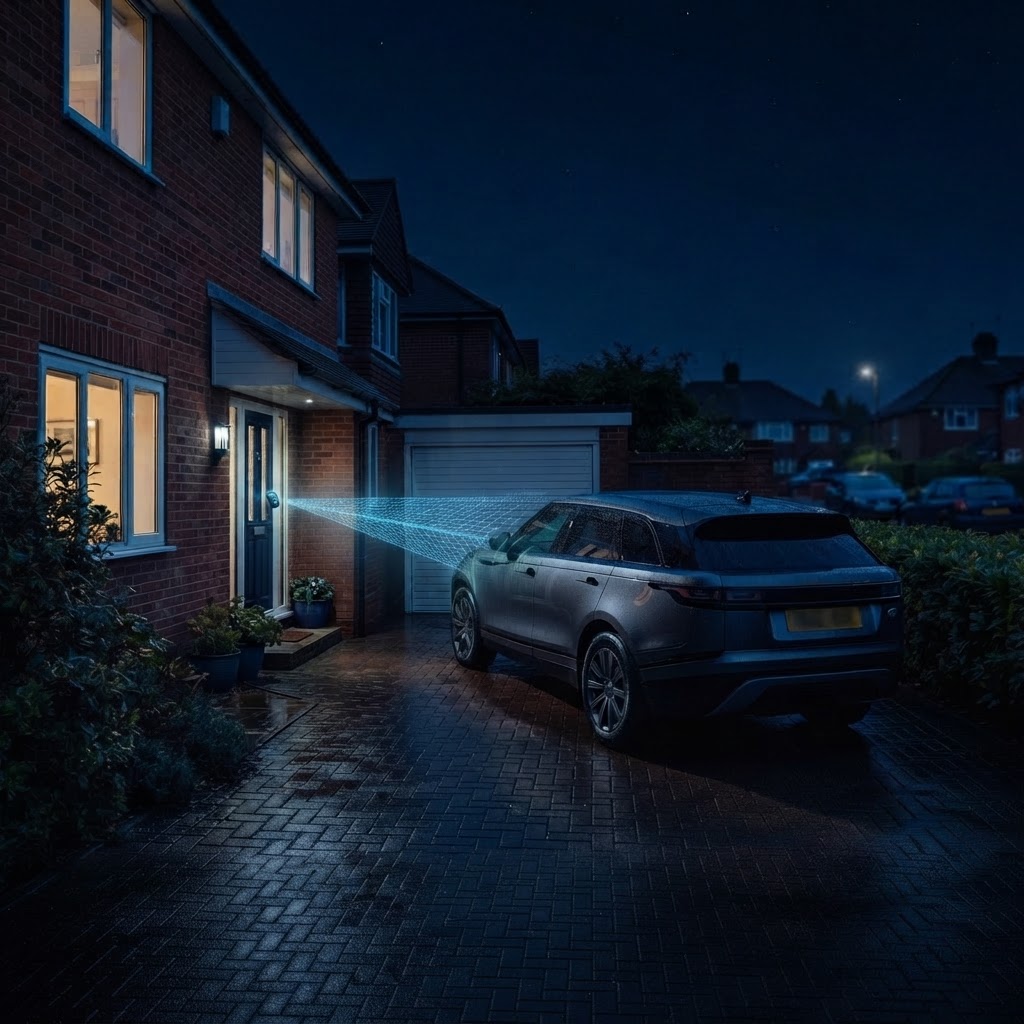
In short: relay theft works because a keyless fob constantly sends out a short-range signal. Two relay devices capture that signal through the wall of your home and re-transmit it to the car on the drive. The car thinks the key is beside it, unlocks, and starts. Block the signal, keep the key away from the car and exterior walls, and add physical security that slows the attacker down.
Do I have keyless entry?
If you can walk up to your car and pull the door handle without pressing anything on the fob, and start the engine with a button while the fob stays in your pocket, your vehicle uses passive keyless entry. It is sometimes called "comfort access" or "smart entry".
A standard remote fob that needs a button press to unlock, and a physical key turned in the ignition to start, is not vulnerable to relay theft in the same way.
If you are unsure, check your handbook or ask your dealer. Some models offer keyless entry as an option, so two otherwise identical cars can behave differently. Keyless entry is one part of the wider picture in our complete UK car theft guide.
The four-stage relay attack
Understanding the sequence shows exactly where to break the chain.
How a keyless relay attack works
The signal can pass through walls and doors. A signal-blocking pouch stops the fob broadcasting.
Why keys can remain vulnerable inside a home
The fob's signal is designed to pass through pockets, bags and clothing for convenience. It also passes through doors, windows and walls. A key on a hallway hook or a console table near the front door is close enough to the car and the exterior for a receiver placed outside to pick up the signal.
The further inside the home the key is kept, and the more it is shielded, the harder a relay attack becomes. Distance and shielding both reduce the signal an attacker can capture. For the scale of the problem, see the latest UK car theft statistics.
Signal-blocking pouches
A Faraday, or signal-blocking, pouch lines a small sleeve with conductive material that blocks radio waves. With the fob inside and the pouch closed, the car should not detect the key.
Quality varies. A worn seam, a damaged lining, or a pouch that is not fully closed will leak signal. Use a pouch for the main key and the spare — a spare left in a kitchen drawer is a common oversight.
A pouch is a useful layer, not a guarantee. Combine it with a physical lock and, where relevant, a tracker.
How to test your signal-blocking pouch
A simple test takes a minute and catches a pouch that has stopped working.
Expand the test steps
- Place the key inside the pouch and close it properly.
- Stand beside the locked vehicle.
- Attempt to unlock or start the vehicle as you normally would.
- If the vehicle still detects the key, replace the pouch.
- Repeat the test periodically — linings wear over time.
This is practical guidance, not a formal security certification. It confirms whether the pouch blocks the signal today.
Turning off the fob's wireless signal
Many fobs can switch their wireless signal off when not in use. The method varies by manufacturer — often a double press of a button, a long hold, or a small switch inside the key casing. When the signal is off, the fob behaves like a traditional key until it is reactivated.
Check your vehicle handbook or ask your dealer for the exact sequence for your model. Some models revert the setting if the battery is changed, so re-test after a battery swap.
Key placement inside the home
Police-backed advice is to keep keys and spares away from the vehicle, doors and windows. A position well inside the home — in a signal-blocking pouch, in a drawer or cupboard away from the entrance — reduces the signal an attacker can reach.
Avoid hallway hooks, console tables by the door, and anywhere visible from a window or reachable through a letterbox.
Steering locks and visible deterrents
A relay attack defeats the electronic lock. A visible physical barrier — a tested steering-wheel lock, a wheel clamp, or pedal protection — is a separate obstacle that takes time and noise to remove.
Thieves often move on to an easier target when a physical lock adds minutes to the job. Look for locks that have been independently tested rather than the cheapest option. Physical locks are one layer in broader layered car-theft prevention.
OBD port protection
Once inside, some thieves use the OBD port to program a new key. A physical OBD port protector locks over the connector and slows that attack. Relocating or hiding the port is a further option on some vehicles.
OBD protection is a useful layer for vehicles known to be targeted this way, but it is not a substitute for stopping the relay attack in the first place. If you are considering a tracker, our car tracker buyer's guide covers the options.
Manufacturer software and security updates
Some manufacturers release software updates that change keyless behaviour or patch known vulnerabilities — for example reducing the fob's signal interval or requiring a movement check before start. Check for recalls and software campaigns through your dealer or the manufacturer's owner portal.
Lock-jamming warning
A separate but related risk: a signal jammer can block the lock command from your fob. You press the button, walk away, and the car stays open. Always physically check a door handle has locked before leaving the vehicle.
A practical keyless-theft checklist
- Keep keys and spares away from the vehicle, doors and windows.
- Use a screened or signal-blocking pouch for both keys.
- Test the pouch periodically and replace it if it fails.
- Consider turning off the fob's wireless signal.
- Manually confirm the vehicle has locked before walking away.
- Add a tested physical lock and, where relevant, a tracker.
Continue exploring vehicle security
Car Theft UK
The main hub: methods, figures and prevention in one place.
ReadCar Theft Statistics
Official ONS and Home Office data, clearly explained.
ReadPrevent Car Theft
A practical four-tier UK vehicle-security checklist.
ReadCar Tracker Guide
Tracker technology, costs and features before you buy.
ReadMotR Secure
A tracker does not stop a relay attack, but it adds the detection and recovery layer that matters once a vehicle has been taken. MotR Secure is designed to work alongside signal blocking and physical security.
Tracker hardware, installation and subscription details will be confirmed before launch.